
Knowledge base
January 05, 2026
Recognizing email threats. Here’s how to prevent phishing and fraud in time
This is how to recognize email threats in time.
E-mail is the largest attack surface within Dutch organizations. Not because technology fails, but because people have to assess what they see. Is a message internal or external. Is the sender really who he says he is. Is a link secure. Cybercriminals know this and deliberately play on doubt and time pressure.
In this blog, you will read what email threats look like in practice, why traditional filters fall short and what has been proven to help prevent damage. Aimed at Dutch organizations, SMEs and IT managers.
Why email is still the preferred attack channel
Almost every employee uses e-mail. Daily, often under time pressure. That makes it an ideal channel for attackers. They don’t have to hack systems. They just need to convince an employee.
Attackers use: – Familiar names and positions within your organization – Trusted vendors or partners – Language and tone appropriate to your organization – Urgency. Act now. Pay today. Respond immediately
Technology can stop a lot, but not everything. Certainly not if an email is technically correct but misleading in content.
Concrete real-world examples
Example 1. The fake director An employee receives an e-mail from the director asking for a quick payment. The name is correct. The tone is correct. The e-mail address seems logical, but is external. One click, one payment, big damage.
Example 2. Overtaken internal mailbox An internal mailbox is compromised. From that account, an Excel file is sent to colleagues. The sender is internal. The file looks familiar. In reality, it contains malware.
Example 3. Custom invoice from a known supplier A supplier sends an invoice with a new account number. Logo, corporate identity and mail history are correct. Only the IBAN has been changed. Payment gone, money lost.
These types of mails often slip through classic spam filters. They are cleverly constructed and technically correct.
Why just a spam filter isn’t enough
Many organizations rely on standard e-mail security. Spam out, block malware and done. That’s no longer enough.
Modern attacks are:
- Targeting specific individuals
- Constructed from multiple mails
- Sent from legitimate accounts
- Free of known malware signatures
The weak link is not the technology, but the receiver’s interpretation.
What has been shown to help in the inbox
Good email security helps employees make the right decision faster. Without having to be security experts.
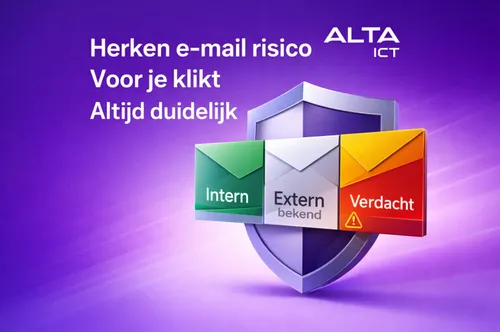
1. Visual recognition of internal and external
An employee should see at a glance whether an email is internal, comes from a known external sender or is completely external. Consider clear banners and use of color.
Internal is different from external. Known external is different from unknown external. That lowers doubt and prevents automatic actions.
2. Context at risk, not just a warning
Just the label suspicious is not enough. Employees need to understand why.
Examples:
– Suspicious link
– Divergent sender domain
– Unusual Annex Type
– Aberrant shipping behavior
Context makes for better choices.
3. Consistent notifications without overload
Too many warnings are ignored. Too few warnings are missed.
Consistent colors, fixed text and recognizable placement in the mail cause employees to recognize patterns. This works better than loose pop-ups or changing notifications.
4. Learning when it counts
Training works best in practice. Not in a loose e-learning, but linked to real emails.
When an employee receives a suspicious e-mail, they immediately learn what to look for. That behavior sticks.
The role of modern email security
Modern solutions combine multiple layers:
- Inbound email protection against phishing and malware
- Internal protection against account abuse
- Analyzing attachments and links for behavior
- Recognition of deviations in sender behavior
- Clear communication towards the end user
AI plays an important role here. Not as a buzzword, but to understand language, intent and context. This way, new and unknown attacks are also recognized.
What this means for Dutch organizations
For Dutch companies, additional factors come into play:
– AVG responsibility in data breach
– Financial loss and liability
– Reputational damage towards customers and partners
– Pressure on IT and security teams
A successful phishing email is no longer an IT incident. It is a business risk.
The ALTA-ICT approach
At ALTA-ICT, we don’t just look at technology. We look at behavior, processes and communication.
Our approach focuses on:
– Clear recognition in the inbox
– Less doubt among employees
– Fewer successful phishing attempts
– Measurable reduction in risk
We work with solutions that fit Dutch organizations and align with ISO27001, ISO9001 and NEN7510 requirements.
No separate tools, but a cohesive approach in which email security is part of your overall security strategy.
In conclusion
The question is not whether your employees ever get a suspicious e-mail. They will.
The question is whether they recognize him immediately or only after things go wrong.
If you want to know what this looks like in your inbox and where you are at risk now, a brief analysis is often enough to gain insight.
Good e-mail security prevents no doubt. It helps employees make the right choice faster.
Want to know more?
Related
blogs
Tech Updates: Microsoft 365, Azure, Cybersecurity & AI – Wekelijks in je Mailbox.